
Yes, you can carry a backpacking backpack on a plane as long as it fits within the airline’s size limits. While most large packs are too tall to meet standard overhead bin requirements, a smaller, mostly empty bag often passes as a carry-on. You should measure your bag before heading to the airport.
Backpacking backpack carry on requirements
Photo: www.reddit.com on Google
Whether your gear fits depends on the specific dimensions of your pack and the airline’s rules. Most major carriers have strict size limits for cabin luggage to ensure everything fits in the overhead bins.
| Your situation | Answer | Why |
|---|---|---|
| Pack is under 22x14x9 inches | Yes | Fits standard airline carry-on limits |
| Pack is over 25 inches tall | Rarely | Too long for overhead bin space |
| Internal frame is rigid metal | No | Can’t be compressed to fit space |
| Bag is packed to capacity | No | Bulges make it exceed size limits |
| Pack is empty or half-full | Yes | Easily compressed into a sizer |
| You’re on a budget airline | Usually not | Smaller personal item limits apply |
The rules for cabin dimensions
The primary limit for overhead bin storage is the physical dimension of the bin itself. Most international and domestic airlines follow a standard limit of 22 inches by 14 inches by 9 inches. If your backpack frame exceeds these dimensions, it won’t fit, even if the fabric part seems small enough.
You must also consider the weight limit. Some airlines, particularly those in Asia and Europe, enforce weight restrictions on carry-on luggage, often capping it at 15 to 22 pounds. You can verify the specific requirements for your flight by checking the Transportation Security Administration carry-on guidelines. If your bag is stiff, it won’t shrink to fit the bin. If your bag has a flexible frame, you can often push it into the sizer.
Packing for the cabin
Photo: www.reddit.com on Google
If you want to bring your backpacking pack into the cabin, you must prepare it to meet the size requirements. Follow these steps to ensure you don’t get stopped at the gate.
- Remove all external gear: Take off sleeping pads, trekking poles, and bulky outer pockets to reduce the pack’s profile.
- Loosen all compression straps: This allows you to pull the fabric inward, making the bag as thin as possible.
- Empty the main compartment: If the bag is half-full, you can fold the top down or squash the sides to fit the measurement box.
- Check the frame height: Stand the bag up and measure from the bottom to the highest point of the frame; if it exceeds 22 inches, it’s too tall.
- Secure dangling straps: Use tape or tuck all loose webbing into the pack so they don’t catch on the bin hinges.
The mistake people make
The most common mistake is failing to account for the rigid frame or the “bulge” of a packed bag. People often measure the fabric when the bag is empty, but a fully loaded pack stretches and expands, which pushes it over the 9-inch depth limit. This usually forces the traveler to check their bag at the gate, which can be an inexpensive alternative compared to other travel costs depending on the airline’s baggage policy. To avoid this, always measure your pack while it’s fully loaded with your standard travel gear.
When to stop and get help
You should stop trying to use your backpack as a carry-on if it fails these checks.
- The frame is rigid and doesn’t fit the airline’s metal sizer box at the gate.
- The bag requires you to remove structural components to fit, which might damage the pack.
- You’re carrying restricted items like large liquid containers or tools that violate security rules.
If you reach these limits, you must check the bag at the ticket counter to avoid extra fees or security delays.
Frequently asked questions
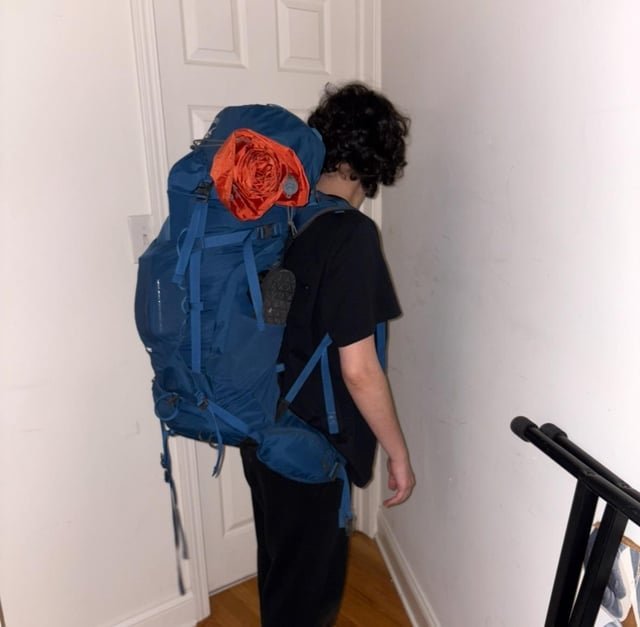
Can I bring a 65-liter backpack as a carry-on?
Usually no, because a 65-liter pack is almost always too tall and wide for standard overhead bins. These bags typically exceed the 22-inch height limit, making them unsuitable for carry-on use on most airlines.
Does the hip belt count toward the size limit?
Yes, the hip belt is part of the bag’s total dimensions. If the belt is bulky or rigid, it adds width that can prevent your pack from sliding into the overhead bin or the airport sizer.
How do I measure my backpack for a flight?
You measure by using a tape measure across the longest, widest, and deepest points of the bag while it’s fully packed. Include the frame, the hip belt, and any pockets that stick out from the main body.
Is it safe to put a backpacking pack in the overhead bin?
Yes, it’s safe as long as you remove sharp items like trekking poles or knives. Always ensure the bag is placed wheels or bottom-first and that no heavy items are pressing against the frame.
What happens if my bag is too big at the gate?
The airline will require you to check the bag into the cargo hold. This often results in a higher fee than if you had checked it at the main desk, and you’ll have to wait at baggage claim.
Does it matter if my pack is soft-sided?
Yes, soft-sided packs are much easier to carry on. Because they lack a rigid frame, you can compress them to fit into tight spaces, which gives you a better chance of meeting the airline’s size requirements.
Conclusion
Start by measuring your pack when it’s fully loaded with your normal gear. If the dimensions are within the airline’s limits, you can expect to bring it into the cabin without issues. If it exceeds them, you must check it to avoid gate fees.